
Capsule Wardrobe for a Small Closet: A Simple Guide
Disclosure: This post contains affiliate links. As an Amazon Associate I earn from qualifying purchases. If you buy through these links, I may earn a small commission at no extra cost to you. Read our full disclaimer.
A small closet works better when it holds fewer, harder-working clothes. A capsule wardrobe for small closet living is not about owning a magic number of items or dressing in only beige. It is a short, planned set of pieces that mix with each other, fit your real life and leave enough space on the rod that you can actually see what you own.
You will learn what a capsule wardrobe is, why it is such a good fit for a tight closet, 12 easy steps to build a capsule wardrobe for a small closet, a few sample lists, common mistakes and a practical FAQ.
Quick answer: A capsule wardrobe for small closet success starts with your real week, not a photo of someone else’s closet. Pick a simple color palette, audit what you already own, choose a short list of core pieces, hang them so you can see every item and store the rest out of the way. Use a one-in, one-out shopping rule, a simple outfit formula and a seasonal refresh so the closet stays small on purpose.
The 12 steps at a glance:
- Build the plan: 1. Define your lifestyle, 2. Choose a color palette, 3. Audit the closet, 4. Pick the core pieces
- Make it fit: 5. Set up the hanging system, 6. Decide what to fold, 7. Give the capsule one rail, 8. Store the off-capsule clothes
- Keep it going: 9. Shop with a rule, 10. Use an outfit formula, 11. Refresh by season, 12. Edit often
What a Capsule Wardrobe for Small Closet Living Really Is

A capsule wardrobe is a limited set of clothes that work together. It usually includes tops, bottoms, a few layers, shoes and maybe a bag or two, all in a palette that mixes easily. Some people keep a capsule of 30 to 40 pieces for a season. Others go smaller or larger. The number matters less than the mix and the fit.
A capsule wardrobe for small closet spaces is also a storage plan. The everyday pieces live on one rail or in one section, where you can see them. Everything else is stored, donated or parked in a less visible spot so it does not compete with the clothes you actually wear.
This is not a challenge to own nothing, and it is not a rule that you must give up color, pattern or comfort. It is a way to make a small closet feel finished. When every hanging item has a job, you spend less time hunting and less money replacing things you already own.
If your closet is already overflowing, our guide on how to organize a small closet with lots of clothes is a good first step. A capsule is easier to build in a closet you can already see into.
It also helps to say what a capsule is not. It is not a contest, and it is not a requirement to throw away anything with a memory attached. You can keep a sentimental jacket in a bin or on a high shelf and still have a capsule wardrobe for small closet days that feels light and easy to use. The point is to stop asking a short rod to hold every chapter of your life at once.
Why a Capsule Wardrobe Works So Well in a Small Closet

A small closet punishes extras. Every hanger you do not wear steals space from a hanger you do. A capsule wardrobe for small closet living turns that limit into a feature: the closet is only supposed to hold the current set, so it can stay comfortable instead of crammed.
Seeing everything is the other advantage. When shirts are not buried, you wear more of what you own and buy less of what you already have. That is useful in any home, and it is essential when the closet is a reach-in or a narrow hall closet.
A smaller closet also costs less to maintain. There is less to wash, less to fold and less to pack when the seasons change. If you want a bigger project at the turn of the year, our January organization challenge pairs well with a capsule reset.
A capsule can also be kinder to the clothes themselves. Pieces that hang with a little space wrinkle less, and sweaters that have a real shelf last longer than a stack that is always falling over. Buying fewer, better-chosen items can also mean less waste; the EPA’s textile data is a reminder of how much clothing is thrown away each year.
12 Easy Steps to Build a Capsule Wardrobe for a Small Closet

Here are 12 steps to build a capsule wardrobe for a small closet you will actually use. You do not have to finish them in one weekend. The first four steps are the plan. The next four make the closet work. The last four keep the system going.
A useful rule: if a step feels like a performance, simplify it. A short, honest list beats a perfect spreadsheet you never open again.
If you share a bedroom closet, talk through the plan before you start pulling clothes off the rod. A capsule wardrobe for small closet spaces works best when both people know which section is everyday, which shelf is storage and how much overflow is allowed. A 20-minute conversation can prevent a weekend of silently moving each other’s hangers. For more bedroom storage help after the rail is set, see our small bedroom storage ideas for adults.
1. Define Your Real Lifestyle, Not an Imaginary One

Start with your week, not with a magazine. How many days do you work at home, go into an office, take kids to school, go to the gym or go out at night? A capsule wardrobe for small closet living should match those days, or you will keep “backup” clothes that never leave the hanger.
Write a short list of outfits you needed in the last two weeks. If you wore jeans and a knit five times and a dress once, the capsule should reflect that. If you need two office looks and one weekend look, plan for that, not for a closet full of event clothes.
Include the weather and the walk. If you commute on foot, shoes and a weatherproof layer are not extras. If you work from the sofa, you still need clothes you are happy to wear on a video call and to the store.
Tip: Ignore other people’s item counts until you know your own week. Thirty pieces can be plenty for one person and far too few for another.
2. Choose a Simple Color Palette

A palette is what makes a small set of clothes feel larger than it is. When most pieces share a few colors, almost everything can mix. For a capsule wardrobe for small closet use, pick two or three base colors, one or two neutrals and one accent if you want it.
Base colors might be navy, black, brown or olive. Neutrals might be white, cream, tan or gray. An accent might be rust, burgundy or a quiet stripe. You do not have to give up pattern. Just keep the patterns in the same family as the bases so they still mix.
Go to the closet you already have and look at the colors you reach for. The palette should start there, not in a brand-new shopping cart. If you already own and wear a lot of black and blue, that is your palette, even if a trend report says otherwise.
Tip: Lay a few favorite tops and bottoms on the bed and take a photo. If the photo looks calm and mixed, the palette is working.
3. Audit the Closet Before You Buy Anything

An audit is a clear-eyed look at what you already own. Take everything out, or work in sections if the closet is shared. Try things on. Keep what fits, feels comfortable and matches the lifestyle list and the palette.
Be honest about “someday” clothes. A suit you have not worn in three years, a size that no longer fits or a trend piece that still has a tag is not a core capsule item. Set those aside to store, sell or donate.
As you go, make a short “already have” list of core pieces: the jeans that fit, the white shirt, the black trousers, the jacket you always grab. This list is the start of the capsule, and it will keep you from buying copies.
This is also the moment to notice gaps. If you have five similar black tees and no comfortable everyday shoe, the gap is the shoe, not another tee.
Tip: Do the audit with good light and a leftover hour, not at midnight when everything looks harder to decide.
4. Pick a Short List of Core Pieces

Core pieces are the workhorses: tops, bottoms, layers and shoes that can make most of your week’s outfits. In a capsule wardrobe for small closet spaces, this list should be short enough to hang with breathing room and long enough to cover your real days.
A simple starting point for one season might be: 7 to 10 tops, 3 to 5 bottoms, 2 to 4 layers, 1 to 2 dresses or jumpsuits if you wear them, 2 to 3 pairs of shoes and 1 everyday bag. Adjust up or down. A teacher, a nurse or a parent of toddlers may need more washable tops. Someone who works in a formal office may need more trousers and shirts.
Choose fabric and fit you will actually wear. A perfect-looking blazer that scratches will not earn its hanger. A slightly boring knit that you put on three times a week is a better core piece.
Tip: If you cannot describe when you would wear a piece in the next two weeks, it may not belong in the current capsule.
5. Set Up a Hanging System You Can See

The closet has to show you the capsule at a glance. Switch to matching slim hangers, hang clothes in one direction and group by type: tops, bottoms, layers. A capsule wardrobe for small closet living depends on visibility more than on a clever app.
Leave a little space between hangers. If the rod is tight, the capsule is still too big, or the off-capsule clothes have not left yet. Facing every hanger the same way makes the rail look calm and makes it obvious when something is missing.
If you share the closet, give the capsule its own section, even if that section is only half the rod. A visual boundary, such as a hanger in a different color at the end of the row, is enough.
Tip: Hang the pieces you wear most at the front of the rail, not hidden behind special-occasion clothes.
6. Decide What Should Be Folded Instead of Hung

Not every core piece belongs on a hanger. Knits, tees, jeans and workout clothes often do better in a short stack or a shallow drawer. A mix of hanging and folding keeps a capsule wardrobe for small closet rooms from using the whole rod on items that stretch or slump on hangers.
Use one shelf or one set of shelf organizers for the folded part of the capsule. Keep the stacks short so they do not fall, and file-fold if that helps you see each item. The same rule applies as on the rod: if you cannot see it, you will not wear it.
Store off-season knits somewhere else, so the everyday stacks stay small. A short, neat stack is part of the look of a working capsule, not a sign that you do not have enough clothes.
Tip: If a stack is always messy, the shelf is too high, the stack is too deep or those pieces need a bin of their own.
7. Give the Capsule One Rail or One Zone

A capsule gets lost if it is mixed into a packed closet. Give it one rail, one side of the closet or one rolling rack, and let that zone be the whole everyday wardrobe. This is one of the steps that makes a capsule wardrobe for small closet living feel real instead of theoretical.
If the closet is a reach-in, the front rod can be the capsule and the back or the high shelf can hold stored extras. If you have only a rack in the room, keep it edited so it looks like a shop rail, not like overflow.
The zone should include space for the next day’s outfit if that helps you. A hook, an empty hanger or the end of the rail can hold tomorrow’s clothes without turning the room into a laundry chair.
Tip: Take a photo of the rail when it feels right. When it starts to look busier than the photo, it is time to edit.
8. Store the Off-Capsule Clothes Out of the Way

The clothes that are not in the current capsule still need a home, or they will creep back onto the rail. Pack seasonal extras in a labeled bin, move formal pieces to a garment bag or a second rod, and donate what you already decided not to keep.
This step is what protects a capsule wardrobe for small closet success. The capsule is not the same as “all the clothes I own.” It is the set you are wearing now. The rest can live under the bed, on a high shelf or in a spare suitcase, just as you would store any off-season wardrobe.
If you have trouble letting go, a box labeled with a date can help. If you do not miss the contents in 90 days, you can donate them with less second-guessing.
Tip: Do not store clothes that are dirty, broken or the wrong size “just in case.” That box will still take space in a small home.
9. Shop With a One-In, One-Out Rule

Once the capsule is in place, new clothes need a rule. A simple one is one in, one out: if a new shirt comes in, a shirt leaves the rail, either to storage, to donation or to the off-capsule box.
Shop from the palette and from the gap list, not from a sale rack at random. A capsule wardrobe for small closet spaces stays small only if new pieces earn their hanger. Ask whether the item works with at least three things you already own, and whether it fills a hole you actually felt last week.
If you enjoy shopping, you can still browse. The rule is about what comes home, not about never walking into a store. A wish list on your phone can hold the fun of a maybe without crowding the rod.
Tip: Wait 24 hours on anything that is not replacing a worn-out essential. Many almost-buys fade by the next day.
10. Use a Simple Outfit Formula

An outfit formula makes a small set feel easy: a bottom, a top, a layer and shoes, with one optional accent such as a scarf or a necklace. Write two or three formulas that fit your week, such as “jeans + knit + sneakers” or “trousers + shirt + loafers.”
This is how a capsule wardrobe for small closet living saves time in the morning. You are not inventing an outfit from 80 mixed pieces. You are picking from a short menu that you already know works.
If you like planning, you can hang the next day’s outfit at the end of the rail. If you do not, the formula is still useful because it shows you whether the capsule has a gap, such as a layer that works with everything or a shoe that can handle a long walk.
Tip: Take photos of five outfits you like. Those photos are a more useful “lookbook” than a complicated chart.
11. Refresh the Capsule When the Season Changes

A year-round capsule can work in a mild climate, but most people do better with a seasonal refresh. In spring and fall, swap the heavy coat for a light jacket, the wool sweaters for short sleeves and the boots for warmer-weather shoes.
The rail can stay the same size. You are not building a second wardrobe as large as the first. You are swapping some of the core pieces and leaving the year-round items, such as jeans, a white shirt or a favorite jacket, right where they are.
This is a good time to clean the closet, check what you actually wore and update the gap list. A capsule wardrobe for small closet use should get easier at each refresh, not bigger.
Tip: Keep a short off-season list so you do not buy a winter sweater in July that you already packed away.
12. Edit Often, Before the Closet Gets Crowded

The last step is the one that keeps the system alive. Once a month, or whenever the rail looks tight, pull one or two pieces you did not wear and send them out of the capsule. Add something back only if you truly missed it.
A capsule wardrobe for small closet living is not a one-time project. It is a habit of noticing what you wear and making a little space again. An edit can take ten minutes. A full rebuild is only needed if your life has changed, such as a new job, a new climate or a new daily routine.
If you share the closet, do a short edit together so one person’s extras do not quietly take over the rail. A small wardrobe stays kindest when everyone using it agrees on the space.
If your life changes suddenly, give the capsule a full reset instead of forcing the old list to work. A new commute, a new baby or a move to a different climate can make last year’s set feel wrong, and that is not a failure of the idea. It is a sign that a capsule wardrobe for small closet living should follow you, not the other way around. Rebuild the lifestyle list, keep what still earns a hanger and let the rest go back to storage or out of the house.
Tip: If you keep putting the same piece back in and never wearing it, it does not belong in the capsule, even if it was expensive.
Sample Capsule Lists for a Small Closet
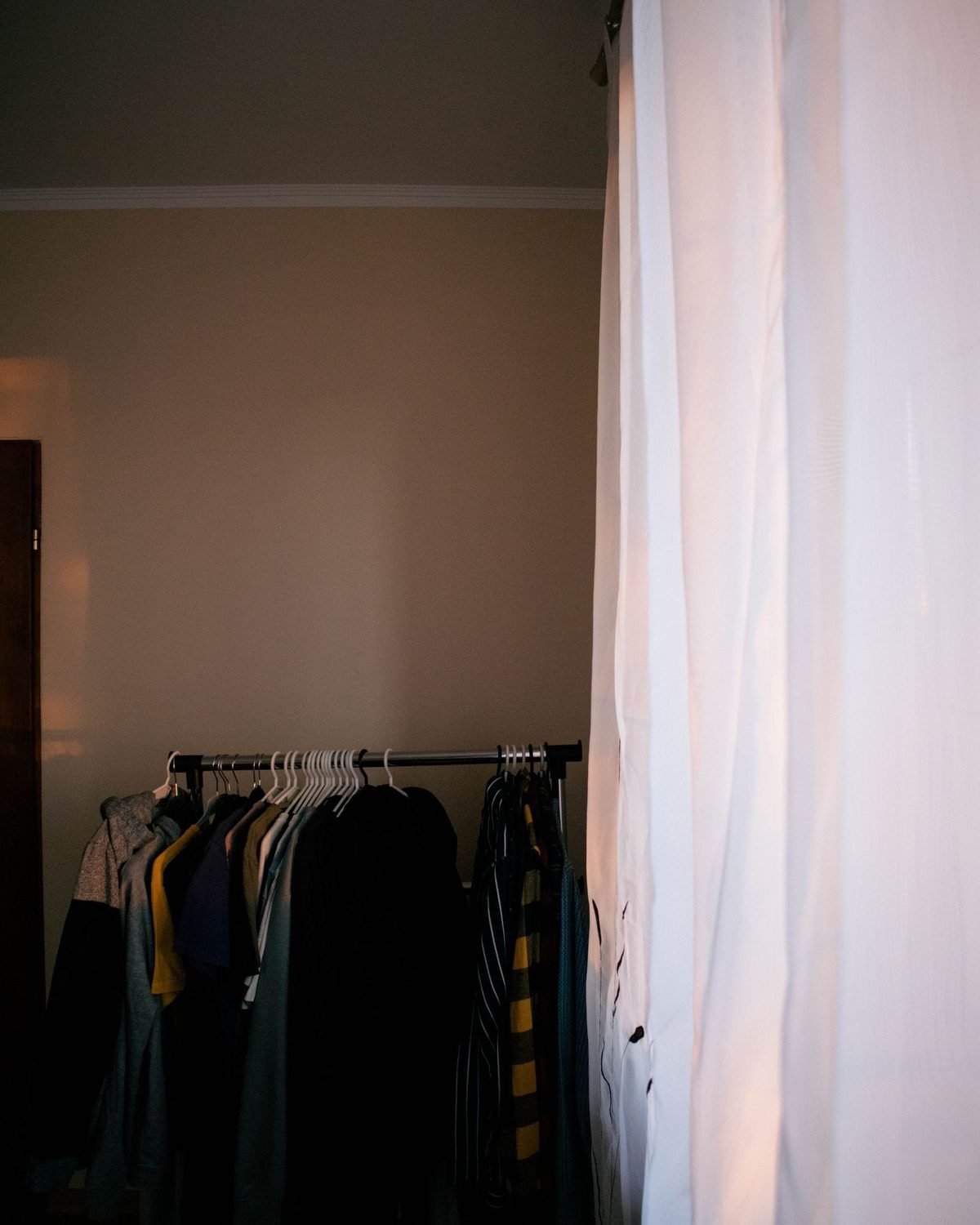
These sample lists are starting points, not rules. Adjust them to your life, and keep the total small enough that the closet can breathe.
A casual work-from-home capsule: 8 tops, 3 pairs of pants or jeans, 2 layers, 1 casual dress, 2 pairs of shoes, 1 bag. Palette: navy, white, tan.
A simple office capsule: 6 shirts or blouses, 3 trousers, 2 knits, 1 blazer, 1 dress, 2 pairs of shoes, 1 bag. Palette: black, white, gray, with one accent color.
A weekend-heavy capsule: 7 easy tops, 2 jeans, 1 skirt or shorts, 2 layers, 1 jacket, 2 pairs of sneakers or loafers. Palette: olive, cream, denim blue.
Add underwear, sleepwear and workout clothes in a drawer, outside the hanging count, so the rail stays visually calm. If you need more than this, add in small numbers and only for a real gap.
A capsule wardrobe for small closet spaces can also include two “fun” pieces that may not mix with everything, as long as they do not take over the rod. A bright shirt or a patterned skirt is more fun when it has room around it.
If a sample list feels too tight, add clothes in the category you actually run out of, usually washable tops or comfortable shoes, and leave the rest of the count alone. A slightly larger capsule that you can live in is better than a tiny one you abandon after a week. The closet, not a number on a blog, is the final judge.
Common Capsule Wardrobe Mistakes in a Small Closet

A few mistakes can make a capsule feel like a chore.
- Copying someone else’s item count. Your week is the better guide.
- Buying a whole new wardrobe to start. Build from what you already wear.
- Choosing a palette you do not actually like. You will not wear it.
- Leaving the extras on the same rail. The capsule needs its own zone.
- Making the set so small you are always doing laundry. Add a few washable tops if that is your real friction.
- Ignoring shoes and layers. They are often the reason an outfit does not work.
- Shopping without a gap list. A sale item that does not mix is still clutter.
- Never editing. A capsule that only grows is just a regular closet with a nicer name.
Capsule Wardrobe for Small Closet FAQ

What is a capsule wardrobe for a small closet?
It is a short, planned set of clothes that mix with each other and live in a visible section of a small closet, with the rest stored or donated so the rod can stay comfortable.
How many pieces should a capsule wardrobe have?
Enough to cover your real week with a little variety, and few enough that you can hang or fold them with space to spare. For many people, that is about 30 to 40 items per season, but the right number is the one that fits your life and your closet.
Can I have a capsule wardrobe if I need work and weekend clothes?
Yes. Plan both parts of the week, and let some pieces do both jobs. A capsule can include two formulas, such as an office look and a weekend look, as long as the colors still mix.
How do I start a capsule wardrobe without buying new clothes?
Audit first, build the first capsule only from what you already own and wear, and make a short gap list. Shop later, and only for the gaps.
What colors work best in a small-closet capsule?
The colors you already wear and like, usually two or three bases and a couple of neutrals. A palette is a tool for mixing, not a rule that everything must be beige.
How do I store the clothes that are not in the capsule?
Use a labeled bin, a high shelf, a garment bag or a suitcase, the same way you would store off-season clothes. Keep them out of the everyday rail.
Will I get bored with a capsule wardrobe?
Most people get bored of a messy closet, not of a short set that mixes well. If you need novelty, add one fun piece at a time and take a seasonal refresh seriously.
Can two people share a capsule-style small closet?
Yes, if each person gets a defined section of the rod and agrees on how much overflow can stay in the closet. Shared baskets and a shared edit once a month help.
Final Thoughts

A capsule wardrobe for small closet living is less about a perfect count and more about a closet you can see and use. Start with your real week, choose a palette from what you already wear, and give the current set one clear rail.
Try two or three of these steps this week. An audit and a hanger swap are the quickest wins. Add a one-in, one-out rule, a seasonal refresh and a short outfit formula as you go, and the closet will stay smaller on purpose.
Save this guide for your next reset, and look at our how to organize a small closet with lots of clothes and small bedroom storage ideas for adults guides if the rest of the room needs the same kind of calm.
If the closet still feels tight after a month, do not add more organizers first. Take five pieces off the rail and live with the smaller set for a week. Most of the time, a capsule wardrobe for small closet success is not missing a tool. It is missing a little more space and a little more honesty about what you actually wear.